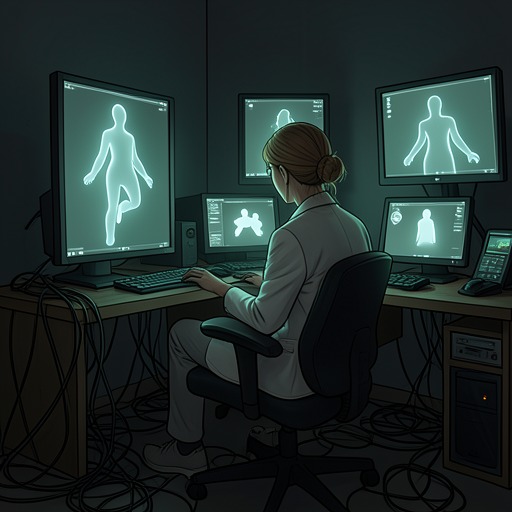
De vervalste Scarpetta-correspondentie met Terri Bridges
Kay ScarpettaThe forged Scarpetta correspondence with Terri Bridges is a central deception in the investigation, turning ordinary email into counterfeit evidence and making Kay Scarpetta appear to have insulted, manipulated, and abandoned Terri. Its decisive significance lies in the separation between identity and authorship: the messages carry Scarpetta’s name, but their dates, technical traces, wording, and impossible chronology expose an unseen operator who is using her identity to control what the investigators believe.
Discovery and Technical Pattern
The correspondence is found among deleted messages from Terri Bridges’s computer. Every deleted email is a communication between Terri and a user named “scarpetta612,” a reference to Scarpetta’s birthday, June 12. The address is linked to the same internet provider used by Terri’s other eighteen accounts, yet “scarpetta612” does not appear in the laptop’s account history. If Terri had created or used the account on that computer, it should have appeared in the machine’s records; no such evidence exists.
Lucy Farinelli traces the messages to an IP address associated with John Jay College of Criminal Justice. The location matters because Terri’s apartment is near both CNN and John Jay, while the apparent Scarpetta account is presented as though it belongs to Scarpetta herself. The technical evidence therefore produces an initial contradiction rather than a solution: the messages are close enough to Terri’s world to implicate her, but the computer history does not establish that she created the account or sent the messages.
The Counterfeit Voice
The most recent message was sent four days before the investigation reaches this discovery, at 11:53 p.m. on December 28, 2007. It is addressed from “Scarpetta” to Terri and offers an apology for failing to keep a promise, explaining the absence through a tragedy and an appearance on CNN. It ends by proposing that they try again and asks whether Terri received the photograph. The message imitates the practical intimacy of an ongoing personal exchange, presenting Scarpetta as busy, apologetic, and still connected to Terri.
Scarpetta immediately denies writing it. The date gives the forgery a surface plausibility because she really was in New York and had discussed the killing of Benazir Bhutto on CNN, but the message’s address is not hers. The counterfeit is thus built from real biographical circumstances. It does not invent an entirely separate Scarpetta; it rearranges verifiable fragments of her public life into a false private identity.
The deception becomes more vicious in an unsent message dated December 31, 2007, at 8:18 p.m. The writer claims to have become brutally candid after three glasses of champagne and an expensive glass of whisky, then tells Terri that forensic psychology may be beyond her because suspects, prisoners, or victims would never accept a dwarf and because a jury might reject her. The message suggests that Terri should consider becoming a morgue assistant, even offering the possibility that she might someday work for Scarpetta.
The email is not merely false; it is calibrated to injure. Its cruelty targets Terri’s stature, professional ambition, and desire for recognition from Scarpetta. It also attempts to make Scarpetta appear contemptuous and socially callous. Scarpetta is relieved that Terri never received it, and that Oscar Bane never read it either, because both might have believed it authentic. The forged voice therefore threatens two relationships at once: Terri’s idealized connection with Scarpetta and Oscar’s understanding of the woman Terri had been communicating with.
The Impossible Timeline
The unsent message transforms the case because its existence cannot be reconciled with either Terri or Oscar as the account holder. Lucy explains that the message was written but never transmitted. Terri was already dead, and Oscar was already in Bellevue Hospital; neither could have written it at that moment. Benton Wesley makes the temporal inference explicit: when the message was created and saved, Terri had been dead for several hours, while Oscar was hospitalized and unable to compose it.
The technical trace also breaks with the earlier pattern. Unlike the prior emails, the unsent message does not originate from John Jay College of Criminal Justice or from any IP address previously encountered. The account is therefore mobile in implication even when the investigators cannot yet identify its user. It can imitate a relationship, borrow Scarpetta’s history, appear connected to Terri’s surroundings, and then produce a message from elsewhere after the supposed correspondents have been removed from the scene.
This chronology changes the value of the emails from possible personal evidence to deliberate forensic staging. The unknown writer knows that the investigators will inspect the account after the murder. A message preserved but never sent has no ordinary recipient function; its practical audience is the investigation itself. Marino recognizes the effect as a game in which the investigators are being moved like pieces on a chessboard. The correspondence is communication, but it is also bait.
Consequences for the Investigation
The forged emails intensify suspicion around Terri and Oscar while simultaneously clearing them of authorship. Before the unsent message is understood, the account can support several misleading interpretations: Terri may have manufactured a relationship with Scarpetta, Oscar may have participated in the deception, or Scarpetta may have concealed a harsh private exchange. Each possibility is weakened when the account continues to generate material after Terri’s death and during Oscar’s confinement.
The correspondence also explains why the investigation repeatedly encounters evidence that seems almost too neatly arranged. Oscar is already under suspicion because shoeprints at Eva Peebles’s home match the shoes he wore when he claimed to have found Terri’s body, and his fingerprints are found on the glass lamp placed in the bathtub. As an arrest warrant is issued and the police search for him, the forged correspondence offers another apparent route back to Oscar. Yet the impossible email prevents the investigators from treating every digital trace as a direct expression of his actions.
The operation’s intended target is especially important. Marino concludes that whoever created the message wants to mock the investigators and hurt Scarpetta in particular. The unknown writer is not simply hiding behind a false account; the writer is staging a confrontation with the people who will decode it. Scarpetta’s professional identity becomes the instrument of the attack, while the investigation’s own procedures—recovering deleted messages, tracing IP addresses, and comparing timestamps—become the channel through which the attacker reaches them.
Narrative Function and Significance
As a story device, the correspondence creates an epistolary layer inside the forensic thriller. Email dates, sender fields, recipient fields, account names, IP addresses, and saved-but-unsent drafts give the investigators fragments that resemble objective records. Their apparent precision produces immediacy, but it does not guarantee truth. Each message is a partial performance by an absent author, and the technical metadata supplies a second, sometimes contradictory narrative beneath the words.
The forged correspondence also makes identity unstable in a specifically modern way. “Scarpetta” is reduced to a username, a birthday-based password-like marker, a recognizable schedule, and a set of phrases that can be imitated. The attacker does not need physical access to Scarpetta’s life in every scene; the attacker needs enough knowledge to make a message plausible and enough malice to make it damaging. The result is a counterfeit self that can act after the real person has denied it.
Its final irony is that the cruelest message never reaches Terri. It survives only as a preserved artifact discovered by those investigating her death. That failed transmission does not make the attack harmless. Instead, it reveals its real destination: the investigators, and above all Scarpetta, are the intended readers. The correspondence consequently shifts the mystery from who exchanged emails with Terri to who is manufacturing a false Scarpetta and why that person wants the investigation to read the forgery as both evidence and insult.